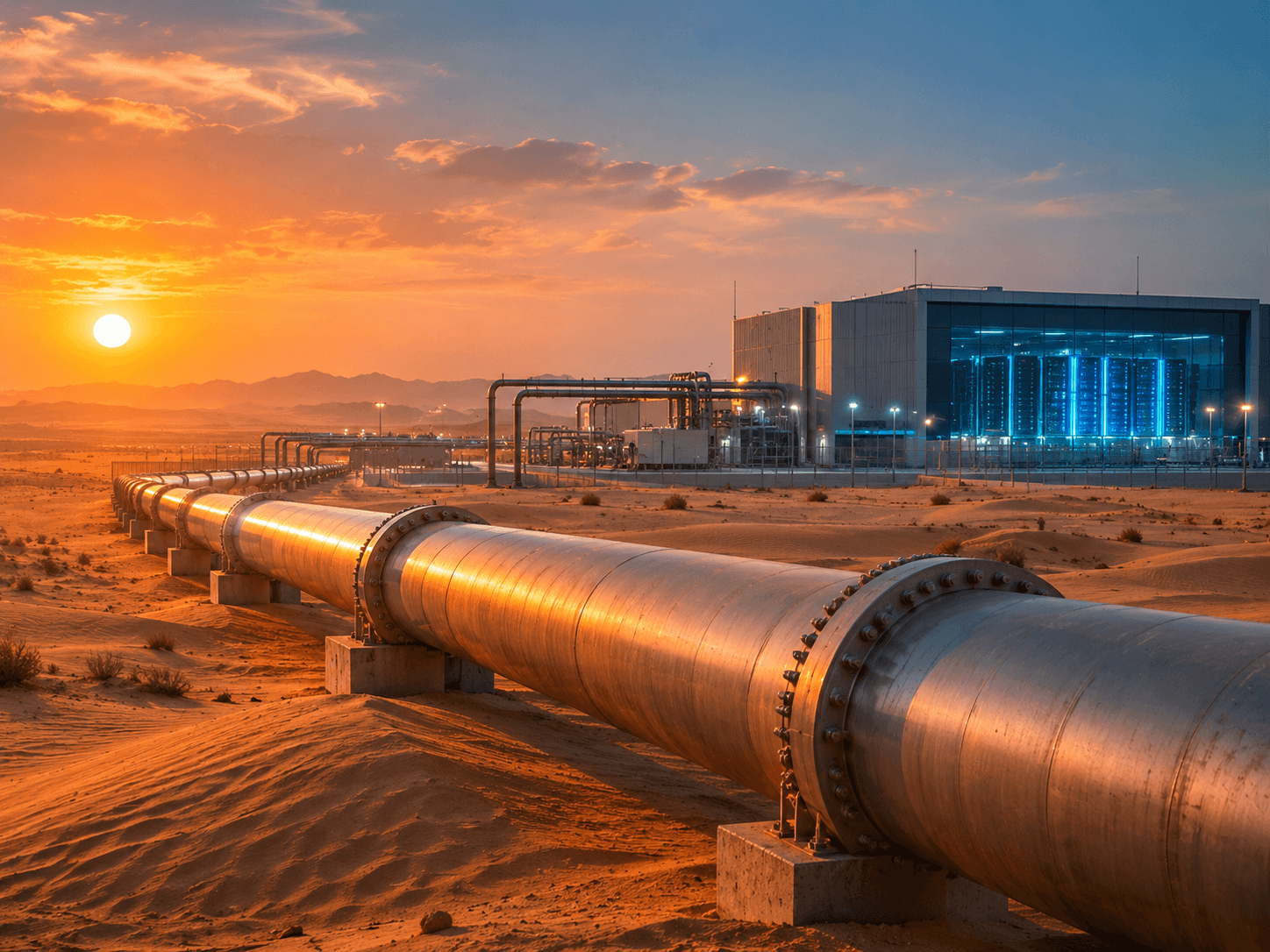
On 1 October 2026, ADNOC Gas awarded an EPC contract for a 56-inch, 127-kilometre sales pipeline. The notable feature of this project is its purpose: the pipeline will supply gas to the second phase of an AI data centre in Abu Dhabi, while also supporting the relocation of EWEC power assets in the Mirfa area of the emirate. For an industry conversation that often treats oil and gas infrastructure and AI infrastructure as separate domains, this award is a useful marker. The two are converging, and the convergence is now generating EPC work.
AI compute is energy-hungry. International Energy Agency projections published through 2026 show data centres globally on track to consume as much electricity as Japan by the end of this year, with AI workloads driving most of the incremental demand growth. Hyperscale operators including Microsoft, Google, Oracle, and regionally HUMAIN are building capacity across the GCC, drawn by data sovereignty policy, national AI strategies, and strong subsea cable connectivity. Every new data centre carries a baseline power demand that has to be met by the local grid. In regions with abundant and economically competitive gas, the practical answer for near-term baseload is gas-fired generation, often paired with renewables and storage to manage the carbon profile. That is why oil and gas EPC awards are now being driven by AI infrastructure requirements.
01Section 1What This Means for Regional EPC Portfolios
The project mix for Gulf EPC contractors is widening. Traditional upstream and midstream work remains active, with ADNOC alone announcing $5.1 billion in EPC packages for the Umm Shaif Gas Cap development on 20 October 2026 and McDermott cutting steel on ADNOC’s Sarb gas project on 16 October 2026. Alongside this, a new category of work is emerging that sits at the intersection of oil and gas, power, and digital infrastructure. Pipelines routing gas to data centre loads. Substations and transmission upgrades supporting hyperscale compute. Combined heat and power installations serving industrial AI campuses. Hydrogen integration where supply chains support it.
For a mid-tier regional contractor planning capability investment over the next three years, this points at a concrete set of disciplines to build or partner into. HV and MV power engineering at the substation and transmission level. Mechanical and electrical design for data centre cooling, including liquid cooling systems that are becoming standard for high-density AI compute. Grid interconnection engineering, including the regulatory interface with transmission system operators. Combined cycle and simple cycle gas generation design for distributed power deployment. These disciplines sit alongside the conventional oil and gas process engineering base and open the door to the integrated project scopes that are starting to appear in regional tenders.
The convergence also has a sovereignty layer that is specific to the region. GCC governments are investing in sovereign AI infrastructure, including Saudi Arabia’s HUMAIN programme and the UAE’s national AI strategy, because data sovereignty is viewed as a strategic national interest. Building physical infrastructure that supports sovereign compute, including the power, gas, water, and cooling supply chains that keep it operational, is a national priority alongside the technology layer itself. Regional EPC contractors are, in effect, being asked to deliver critical national infrastructure for the AI era, with the governance expectations that come with that role.
Planning a project?
Talk to PMO Global about delivering it from bid to build.