
Offshore inspection and maintenance has historically been one of the most dangerous and expensive activities in the oil and gas lifecycle. Divers working at depth. Rope access technicians on flare stacks. Shutdown windows measured in days of lost production. In 2026, autonomous and semi-autonomous robotics are reshaping how this work is done, with measurable implications for safety, cost, and the pace at which assets can be assessed and maintained. The technology is in operational use across the region, and the direction is clear.
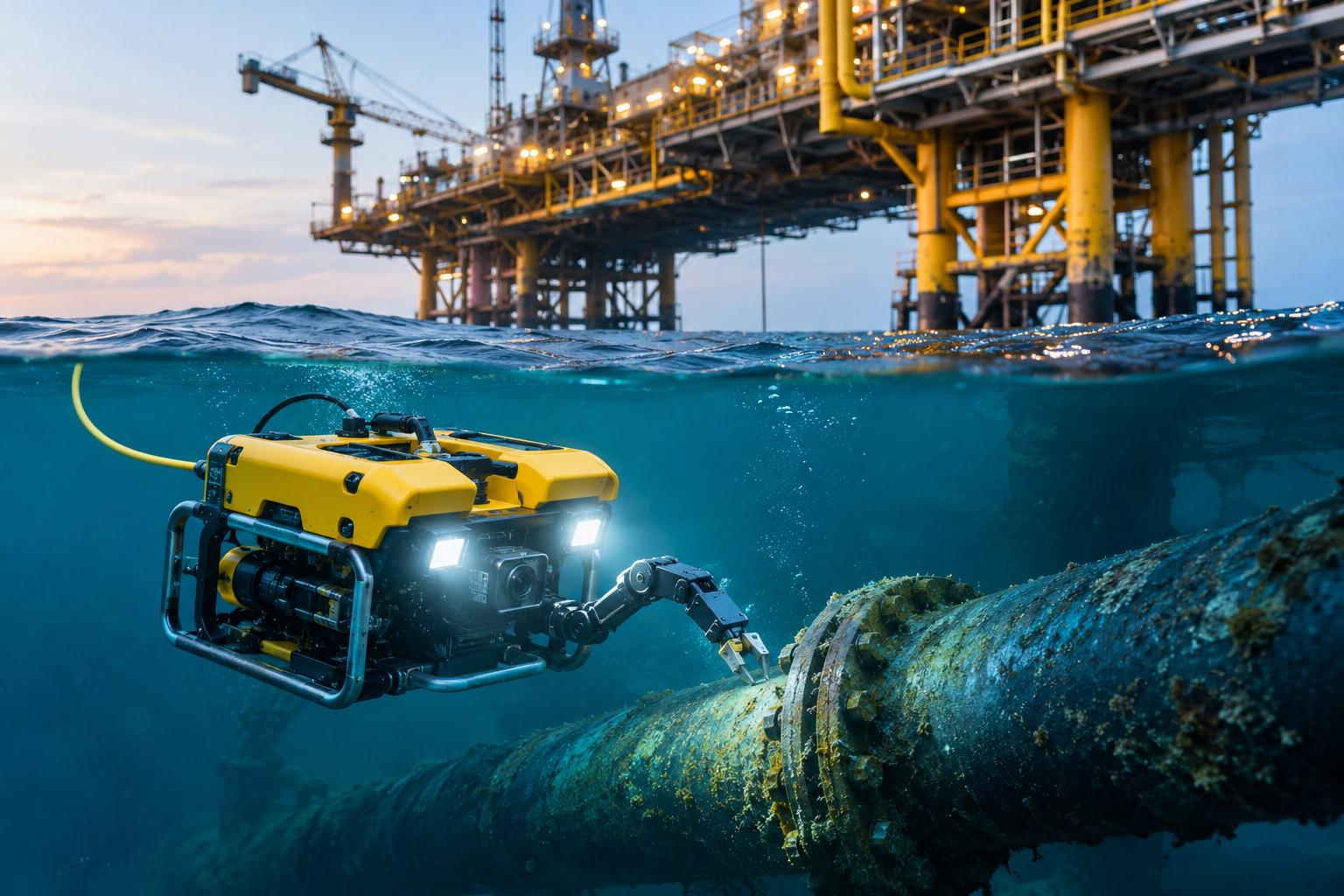
Four categories of robotic systems are now in production use on regional offshore assets. Autonomous underwater vehicles, including AUVs and ROVs, carry out subsea pipeline inspection, structural assessment, and intervention work previously requiring diver support.
Topside crawlers and climbing robots inspect vessel internals, tank floors, and structural members, often with ultrasonic thickness measurement capability built in. Aerial drones with hybrid optical and thermal sensors inspect flare stacks, elevated process equipment, and large structural installations. Specialised in-pipe robotics handle internal pipeline inspection where external access is impossible or impractical.
The economic case has moved past speculation. Published operator data from the North Sea and Gulf of Mexico shows drone-based external inspection of flare stacks and elevated structures cutting inspection cost by 60 to 80% against rope access, while compressing the inspection window from days to hours. For subsea work, autonomous and resident vehicles supervised from shore are eliminating the need for support vessels on routine inspections, with vessel day rates running at $100,000 to $250,000 depending on specification. On a modest fleet of assets, those savings pay back the robotics investment inside two years, with the HSE benefit of removing personnel from working at height or over water on top of the financial case.
01Section 1What Changes in the Operating Model
Robotics change more than the inspection method. They change the data model around asset integrity. Where traditional inspection produced a report, modern robotic systems generate structured data streams: ultrasonic thickness maps, high-resolution imagery, point cloud scans, temperature profiles. That data feeds directly into asset integrity management systems and digital twins, closing the loop between field inspection and operational decision-making in a way that paper-based reports never could.
The skills profile offshore shifts in parallel. Inspection teams increasingly include robotics operators, data analysts, and remote supervision engineers alongside traditional inspection trades, and for regional operators building out remote operations centres, inspection robotics integrates naturally into the shore-based model.
02Section 2Where the Approach Still Struggles
Robotic systems vary in maturity across applications. Confined space inspection in complex geometries remains challenging for autonomous navigation. Highly cluttered subsea environments stretch the limits of current ROV autonomy. Interpretation of inspection data still requires experienced human judgement for borderline findings, and the regulatory frameworks around robotic inspection, including certification equivalence to traditional methods, vary across jurisdictions.
The deployments that struggle commercially tend to share a pattern: they treat robotics as a direct substitute for existing inspection methods without redesigning the workflow around what robotics make possible. The operators capturing real value integrate robotic inspection into continuous asset integrity programmes, moving on from the discrete annual campaign model, and use the richer data stream to shift from calendar-based to condition-based intervention.
By the end of this decade, autonomous and semi-autonomous robotic inspection will be the default for most routine offshore and industrial inspection scopes in the region. Human inspectors will focus on complex judgement calls, intervention supervision, and the asset integrity decisions that genuinely require expert interpretation. The economic, safety, and data quality case is strong enough that the direction is settled; the practical question for regional operators and contractors is pace of adoption. The programmes investing in capability now will be running leaner, safer, and better-informed inspection operations through the next phase of regional offshore activity.
The programmes investing in capability now will be running leaner, safer, and better-informed inspection operations through the next phase of regional offshore activity.
Planning a project?
Talk to PMO Global about delivering it from bid to build.